
Optimizing Your Salary vs. Dividend Mix: Advanced Strategies for Physician Compensation
AUTHOR: Bluestar equity
As a physician, running a practice is a rewarding, yet overwhelming venture. On top of managing patient care and handling business operations like hiring staff, finances deserve their own bucket and the prospect of paying yourself falls right into that category. But how do you plan on paying yourself? Do you take a salary, declare dividends, or use a mix of both? This decision isn’t just about immediate cash flow. It affects your taxes, retirement savings, and even Canada Pension Plan (CPP) benefits.
This blog article will serve as a guide to helping you decide what path works best for when it comes to paying yourself as a physician, all while complying with tax rules. With the right planning and guidance from our advisors at Bluestar CPA, you can retain more of your earnings and reap the benefits of those savings.
Let’s start with the basics. How does a salary work versus dividends? Here’s a quick breakdown:
Salary
• Paid from your Professional Corporation and taxed as personal employment income.
• The corporation deducts your salary as an expense, which lowers its taxable income.
• Salary creates RRSP room - 18% of the previous year's earned income, up to $32,490 for 2025.
• Salary is subject to CPP and the new CPP2 contributions. These payments help build your future retirement benefits.
Dividends
• Dividends are paid out of after-tax corporate profits.
• They are taxed personally at dividend tax rates, which can be higher than salary tax at many income levels.
• Dividends do not create RRSP room.
• Dividends are not subject to CPP or CPP2 contributions.
• No payroll remittances are required if taking only dividends.
• Payments to family members may be limited by Tax on Split Income (TOSI) rules.
Salary Vs. Dividends- A Scenario
To put things into perspective, let’s take a look at a scenario where one physician chooses to earn take a personal salary while the other opts for taking out dividends.
Meet Dr. Asha and Dr. Ben, both with identical professional corporations in Ontario and each earning $300,000 before compensation. They each need approximately $150,000 for personal living costs yearly (after tax).
Dr. Asha decides to take a salary of $150,000 from her corporation. Dr. Ben instead takes a $150,000 dividend from his corporation’s after-tax profits. Here is the breakdown on Dr. Asha and Dr. Ben’s strategies:
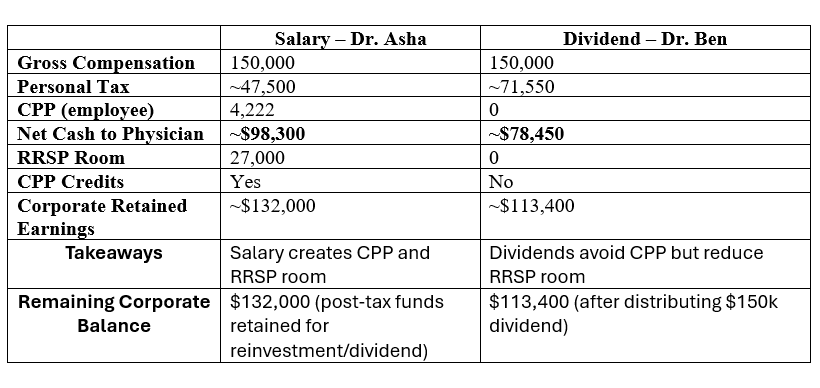
At a $150,000 compensation level in Ontario, salary results in higher personal net cash due to high non-eligible dividend tax rates. Dividends become more efficient when extracting additional surplus beyond personal lifestyle needs or when corporate tax deferral advantages are maximized.
Tips for an Optimal Strategy
Revisit Annually: The perfect solution does not exist. You need to re-evaluate your salary-dividend strategy each year based on your cash needs, tax rule changes, and new goals. One year you might need more personal income (e.g., big purchase or home down payment) in which case you would lean toward dividends for extra cash at lower tax. Another year you might prioritize RRSP, in which case you’d opt for the salary option.
Consider a Mixed Approach: Many physicians choose a hybrid strategy; a salary to generate RRSP room and CPP, and dividends for anything beyond that. This way, you get the best of both worlds: sufficient RRSP room and CPP credits, and the rest comes out in the more tax-favored dividend form.
Document Your Rationale: For audit protection, always document dividends properly and ensure any salary is reasonable for the work performed (especially if paying family members). Although as the business owner you can technically pay yourself any amount of salary, it’s wise to have board resolutions or notes justifying the approach. Consider a T4/T4SUM as well as preparing a compensation memo for the CRA trail. Managing Partner at Bluestar CPA, Jordan Novack, routinely helps our clients document their compensation strategy and KPA Lawyers, our partner law firm can provide assistance as well.
Watch for Regulation Changes: Tax rules can evolve. For instance, if dividend tax rates or the small business deduction rules change, your strategy may shift. Stay in touch with your tax advisor for updates. 2025 federal lowest tax rate effectively 14.5 % for the year (15% to 14% mid-year).
Conclusion
Deciding between salary and dividends is a sophisticated exercise in integration and planning. The optimal solution often involves a thoughtful combination rather than an all-or-nothing choice. It should align with your retirement planning, your current lifestyle needs, and your long-term wealth-building strategy. This is where Bluestar CPA’s expertise with advanced corporate tax planning for physicians truly adds value. We help physicians like you crunch the numbers, compare scenarios, and implement a tailored compensation strategy. The right mix can save you tens of thousands in taxes over a career and ensure more of your money is working for you.